
Peak shaving plus: a secondary control mode for the battery
Warning
This function is currently available for public testing only (public beta). Future access may be subject to an additional license.
When the default working mode of the storage devices is "Peak shaving", the battery normally does nothing else than shaving the grid peaks between the peak shaving thresholds. With a secondary control mode, the battery does something useful in the meantime: a part of the battery, the critical reserve, is reserved exclusively for peak shaving, and the rest of the battery is controlled according to the secondary control mode, cost optimization or self-consumption optimization.
Peak shaving is always guaranteed. When the grid power exceeds the peak shaving thresholds, the SmartgridOne Controller shaves the peak with the whole battery, not only with the critical reserve: the partition of the secondary control mode is used for peak shaving first, and only when that partition is empty, the critical reserve is used. The critical reserve is therefore the energy that is still available for peak shaving in the worst case, after the secondary control mode has emptied its own partition. The secondary control mode itself never touches the critical reserve.
Settings
On the settings page, with "Peak shaving" selected for the storage devices, the option "Secondary control mode (public beta)" appears below the dropdown:
| Option | Behaviour |
|---|---|
| Peak shaving only / no secondary control mode (default) | The whole battery is used for peak shaving. |
| Cost optimization | A reserved partition is used for peak shaving, the rest follows the cost optimization settings that appear under "Cost optimization partition settings". |
| Self-consumption optimization | A reserved partition is used for peak shaving, the rest maximizes self-consumption. |
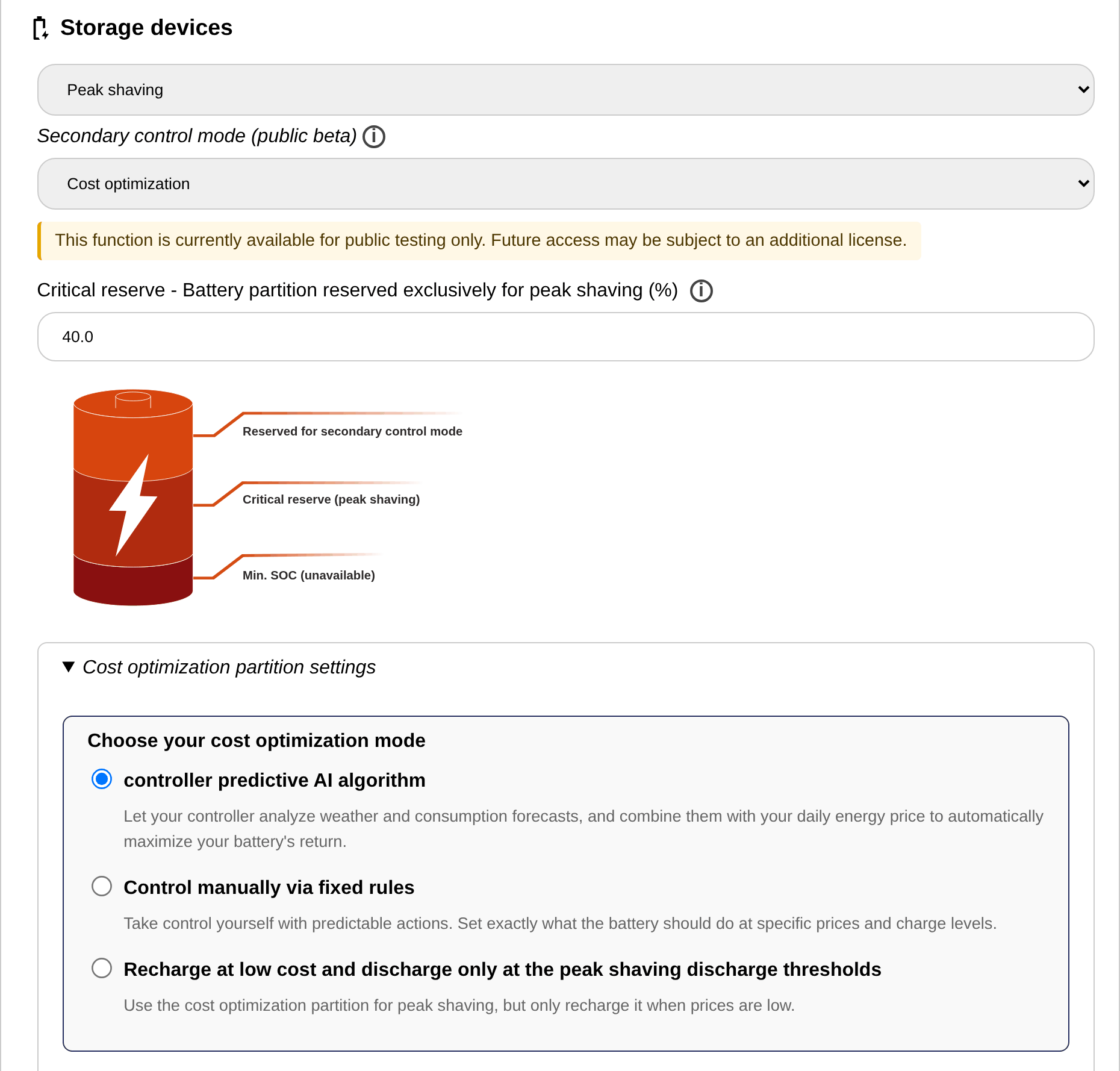
Critical reserve
The critical reserve is the battery partition reserved exclusively for peak shaving, as a percentage of the total battery capacity (at least 10%, 40% by default). The secondary control mode never discharges the battery below the top of this partition. Peak shaving does use the reserve, but only after the partition of the secondary control mode is empty and as long as the grid power exceeds the peak shaving thresholds. The reserve is recharged as soon as the grid power drops below the "Start charging below" threshold, so that it is full again for the next peak.
Note
The percentage goes on top of the minimum battery state of charge. If the minimum state of charge of the battery is 20% and the reserved part is 40%, the reserved part lies between 20% and 60% of the real battery.
Recharging the partition at low prices only
For the cost optimization partition, the mode "Recharge at low cost and discharge only at the peak shaving discharge thresholds" is available among the cost optimization modes. The whole battery is then used for peak shaving only: the critical reserve is kept full whenever possible, and the cost optimization partition is recharged when the prices are low, but it is never discharged for cost reasons, even when the prices are high and the local demand is low.
Related
- On Swiss sites, the capacity tariff schedule switches the batteries to peak shaving plus during the capacity tariff periods only, with the same critical reserve.
- The peak shaving thresholds themselves are explained in Battery peak shaving.