
Advanced/dynamic contract
The advanced dynamic energy contract configurator is available for any location and currency. This configurator requires you to specify a default rule and a list of extra rules, where each extra rule has an associated timing. This allows for the configuration of energy contracts where prices are time-dependent (e.g., dual tariffs).
Figure: Configuration of Engie Flow variable (BE) contract as of April 2026, for a dual-tariff digital meter located in the Fluvius Imewo network. Note that the off-peak tariff is the default rule and peak tariff the additional rule. The peak rate will be applied on weekdays between 7 am and 10 pm, meaning that the off-peak tariff will be active during weekends and night time hours. Download the PDF
Rule configuration
Each rule specifies at least either a consumption or an injection price formula and (for non-default rules) a timing. In accordance with this, the rule configuration page has three sections:
- General: Specify the name, scope (consumption/injection), and timing.
- Data sources: Import data (like market prices) for use in formulas. E.g. adding a specific day-ahead market as a data source, enables a “day-ahead price” variable which may then be used in the formulas.
- Formula: Compose injection/consumption formulas via a drag-and-drop interface.
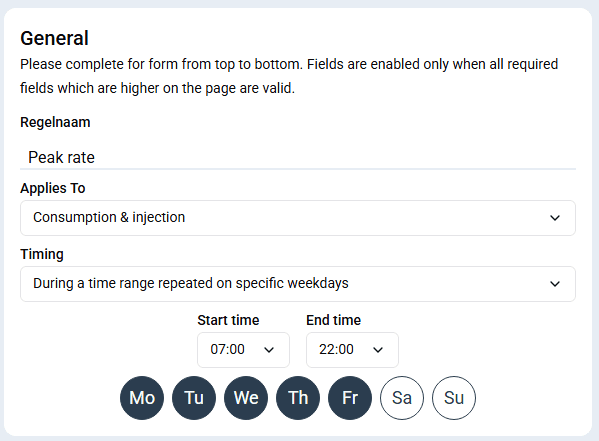 Figure: Typical settings of a peak rate rule. Peak hours depend on the specific location but in Belgium 7 a.m. to 10 p.m. is the most common.
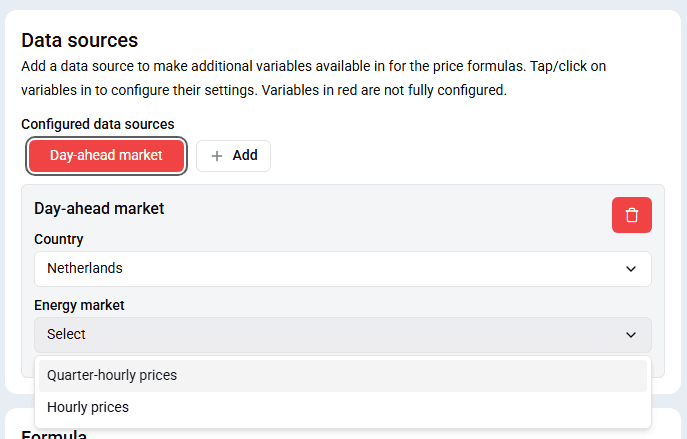 Figure: Example configuration of a day-ahead market price. The price data source is highlighted and in red, meaning it can be edited, but its configuration is not yet completed. The Netherlands are selected, but a choice between quarter hourly and hourly prices remains to be made. As of Oct. 2025, quarter hourly prices are commonly used.
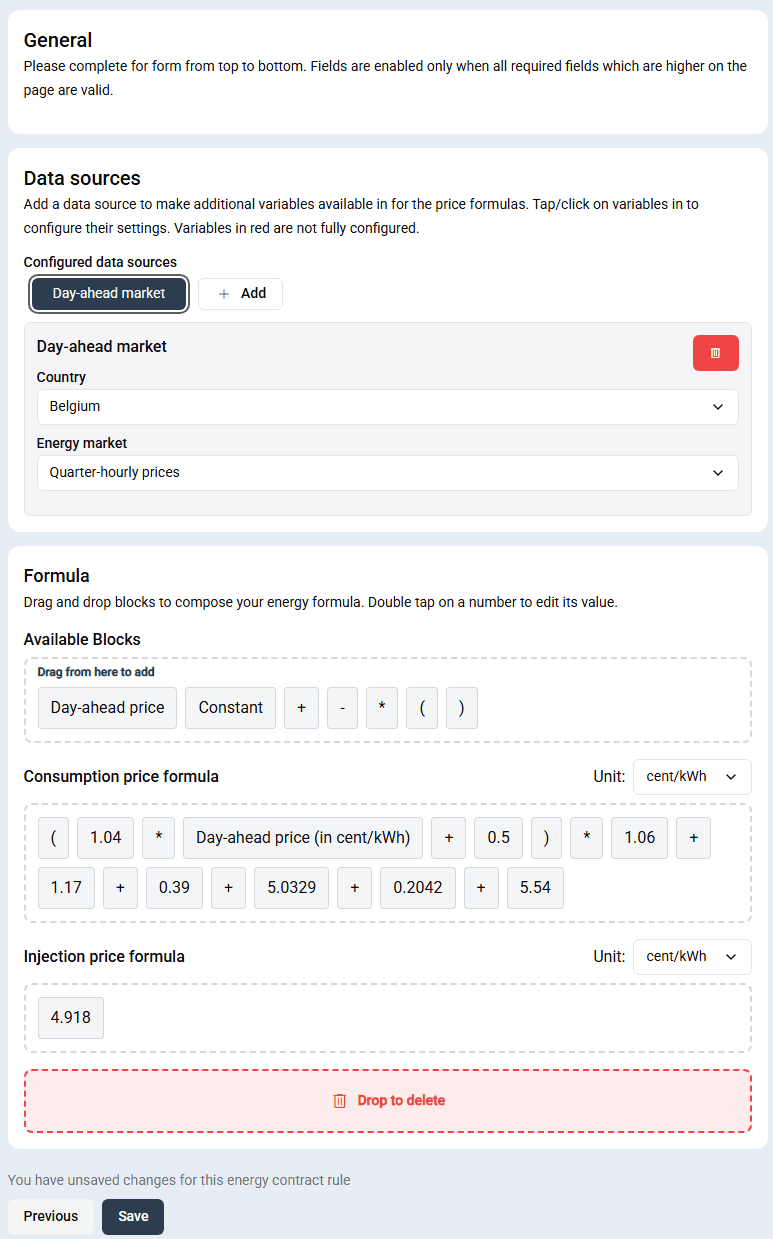 Figure: Example configuration of an Energie.be dynamic contract (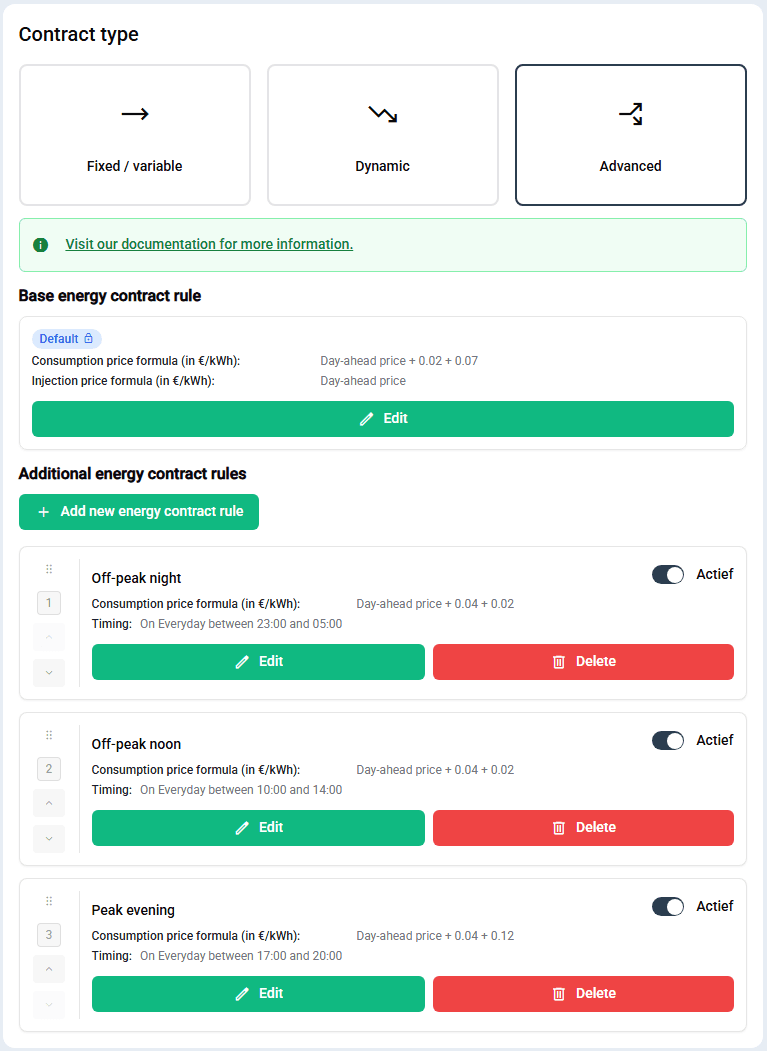
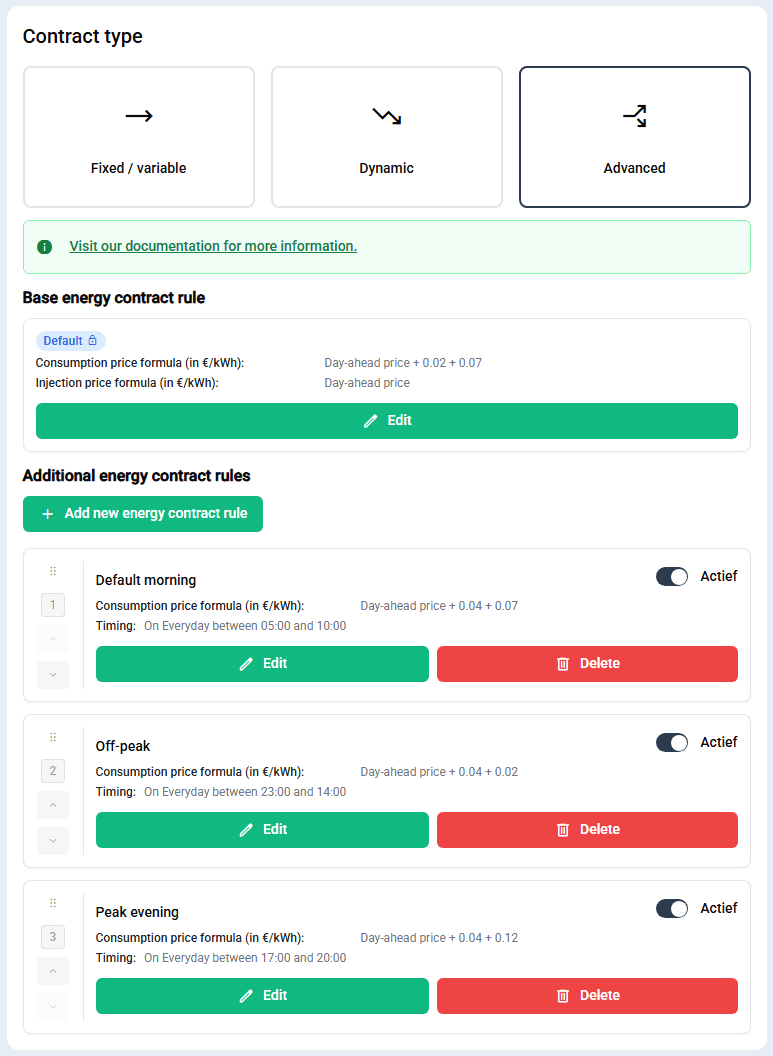 Figure: In Germany, net tariffs are time dependent. Often, there is a default rate (Standardtarif), a more expensive peak rate (Hochtarif) and a cheaper rate (Niedertarif). The images shows how two ways configure prices for an energy provider offering a dynamic tariff where the energy price equals the epex spot plus 4 cents/kWh, with net tariffs as follows: